Thunderstorm Warning Systems
Malaysia — Industrial Lightning Warning
for Factories & Plants
Malaysia records up to 280–293 thunderstorm days per year in major industrial zones. Outdoor workers in factories, petrochemical plants, ports, and construction sites face life-threatening lightning exposure every working shift. A Thunderstorm Warning System gives your facility 10–20 minutes of advance warning — enough time to safely evacuate exposed areas before the first lightning strike.
TAKO is Malaysia’s trusted supplier and installer of industrial-grade Thunderstorm Warning Systems — delivering real-time lightning detection, automated site-wide alerting, and all-clear signals to protect your workforce across Malaysia’s highest-risk industrial zones. Explore the Best Thunderstorm Warning System in Malaysia — available from TAKO with full installation and commissioning.
What Is a Thunderstorm Warning System and Why Does Malaysian Industry Need One?
A Thunderstorm Warning System is an industrial safety device that continuously monitors atmospheric electrical conditions, detects approaching lightning and thunderstorm activity at distances of up to 40 km, and automatically activates site-wide audible and visual alerts — giving outdoor workers at Malaysian factories, plants, and industrial sites critical advance warning to reach safety before lightning strikes.
The Malaysia Lightning Reality: Malaysia is ranked among the top three countries in the world for lightning frequency. With industrial zones in Penang, Selangor, Johor, Pahang, and Sarawak recording 185–293 thunderstorm days per year, outdoor shift workers face lightning risk during every single working day of the year. A lightning warning system for factory Malaysia is no longer optional — it is a fundamental industrial safety requirement. Read the full product details on the Best Thunderstorm Warning System in Malaysia.
How Thunderstorm Warning Systems Work
Industrial Thunderstorm Warning Systems use one or more of the following detection technologies to continuously scan for approaching electrical storm activity — completely independent of internet connectivity or third-party data feeds.
- Electric Field Mill (Ground-Based): Measures the static electric field at ground level. Rising electric field values indicate the approach of a thunderstorm cell, triggering warnings before the first lightning strike occurs in the area.
- Lightning Strike Detection: Detects radio frequency (RF) signals emitted by lightning discharges at distances up to 40 km — identifying both cloud-to-ground and cloud-to-cloud lightning activity.
- Combination Systems: Advanced units combine electric field mill measurement with lightning strike detection for maximum detection accuracy and minimum false alarm rates — recommended for critical industrial facilities.
- Integration with Online Lightning Networks: Optional enhancement using real-time data from Malaysia’s lightning detection network to supplement local sensor readings.
Thunderstorm Warning System Alert Protocol
A well-configured lightning warning system for factory Malaysia uses a tiered alert protocol that escalates from early advisory through to full evacuation order, then gives a clear all-clear signal when the storm has passed:
Alert thresholds and distances are configurable to match your facility’s specific layout and operational safety requirements.
Malaysia’s High-Risk Industrial Zones — Where Thunderstorm Warning Systems Are Essential
Every major industrial zone in Malaysia sits within a region recording over 185 thunderstorm days per year. Below are the key industrial areas where TAKO deploys Thunderstorm Warning Systems and lightning warning systems for factories — with site-specific risk context for each cluster.
Bayan Lepas FIZ & Prai Industrial Estate
Home to Intel, Bosch, Motorola, and hundreds of electronics and semiconductor manufacturers. Outdoor loading docks, cooling tower service areas, and shift change assembly points create constant lightning exposure. The highest recorded Ng values in Peninsular Malaysia.
Shah Alam, Klang & Port Klang Industrial Corridor
Malaysia’s largest industrial cluster — automotive assembly, logistics hubs, cold chain facilities, and Port Klang terminal operations. Extensive outdoor yard areas, crane operations, and container handling make a Thunderstorm Warning System a critical safety requirement.
Rawang, Sg. Buloh & Kapar Industrial Zones
Building materials, steel fabrication, rubber processing, and heavy manufacturing with large outdoor handling and storage areas. Workers operating forklifts, heavy machinery, and rail loading sidings face direct lightning exposure during storms.
Pasir Gudang & Tanjung Langsat Petrochemical Zone
Malaysia’s largest petrochemical and chemical manufacturing hub, including PETRONAS-linked facilities, storage tank farms, and jetty operations. Lightning strikes on outdoor tank farms and loading arms carry extreme fire and explosion risk — making Thunderstorm Warning Systems mission-critical.
Iskandar Malaysia — Nusajaya & Senai Industrial Park
Rapidly expanding industrial and logistics zone featuring F&B manufacturing, automotive parts, and aerospace MRO facilities. Large rooftop plant equipment areas, outdoor testing facilities, and open assembly yards require monitored lightning safety protocols.
Gebeng Industrial Estate & Kertih Petrochemical Zone
PETRONAS Kertih Integrated Petrochemical Complex and Gebeng’s chemical manufacturing corridor. Exposed pipeline infrastructure, outdoor flare systems, and shift workers on tank farms and jetties face some of the highest combined lightning and explosion risk in Malaysia.
Ipoh & Batu Gajah Industrial Areas
Cement manufacturing, rubber processing, and mining equipment industries with large outdoor operations. Ipoh records up to 278 thunderstorm days per year — among the highest in Malaysia — making every outdoor shift a high-risk thunderstorm event.
Bintulu SCORE Industrial Zone & Petrochemical Hub
PETRONAS LNG complex, ASEAN Bintulu Fertiliser plant, and the Samalaju Industrial Park’s aluminium smelters and steel mills. Bintulu is one of the highest lightning-risk industrial areas in all of Malaysia — with massive outdoor industrial infrastructure requiring comprehensive Thunderstorm Warning System coverage.
Kota Kinabalu Industrial Park (KKIP) & Lahad Datu
Palm oil processing mills, timber products, and food manufacturing in East Malaysia’s highest-growth industrial corridor. Palm oil mill operations — with outdoor FFB receiving platforms, pressing areas, and tank farms — are among the most lightning-exposed industrial workplaces in Malaysia.
Kulim Hi-Tech Industrial Park (KHTP)
Malaysia’s designated high-technology industrial zone for semiconductor wafer fabrication, advanced electronics, and aerospace components. Outdoor chemical delivery areas, sub-fab utility yards, and clean room exhaust systems require monitored lightning safety protection.
KLIA Aeropolis & Sepang Industrial Park
Aviation ground handling, cargo operations, aircraft maintenance, and fuel farm operations at Malaysia’s main international aviation hub. Lightning is the primary weather-related cause of aircraft ground handling fatalities worldwide — making Thunderstorm Warning Systems essential for all airside industrial operations.
Palm Oil Mills — Felda, Felcra & Private Estates
Over 450 palm oil mills operate across Peninsular Malaysia and East Malaysia, many in rural high-lightning-activity areas. FFB receiving ramps, boiler yard operations, and effluent pond maintenance expose mill workers to lightning risk during every thunderstorm — a lightning warning system for factory Malaysia is critical for all mill operations.
Industrial Thunderstorm Warning System — Key Features
TAKO’s industrial Thunderstorm Warning Systems are purpose-built for Malaysia’s harsh tropical environment — high humidity, saltwater-adjacent coastal industrial zones, and continuous high-temperature operation. Explore the full specification on the Best Thunderstorm Warning System in Malaysia product page.
Long-Range Detection
Electric field and lightning strike detection up to 40 km radius — providing 10 to 20 minutes of advance warning before storms reach your facility. Suitable for large industrial complexes, ports, and open-area facilities.
High-Power Outdoor Siren
Industrial-grade weatherproof siren rated for outdoor environments — audible above factory floor noise levels up to 1,200 metres. Multiple tones for Warning, All-Clear, and different alert levels.
Visual Strobe Alert
High-intensity rotating or LED strobe warning lights ensure visibility in noisy industrial environments where workers may be wearing hearing protection — PPE-aware alert design.
SCADA & DCS Integration
Relay contact outputs, 4–20mA analogue, Modbus, or digital communication for direct integration with your factory SCADA, DCS, building management system, or PA system. Enables automated process hold and crane halt commands.
Tropical Environment Rated
IP66-rated outdoor enclosures, stainless steel hardware, UV-resistant housings, and corrosion-protected finishes designed for Malaysia’s salt-laden coastal industrial atmosphere and continuous high-humidity tropical climate.
Remote Monitoring & Alerts
Optional SMS, email, and app-based notification to Safety Officers and EHS Managers — including remote real-time dashboard showing current electrical field intensity and lightning activity radius.
Event Data Logging
Full time-stamped data logging of all detected lightning events, field intensity readings, alert activations, and all-clear signals — essential for DOSH incident reporting and ISO 45001 safety management documentation.
Configurable Alert Thresholds
Alert distances and thresholds are configurable to match your facility’s specific layout, topography, and operational requirements — from compact factory sites to large petrochemical complexes covering multiple square kilometres.
Backup Power System
Integrated UPS backup power ensures the Thunderstorm Warning System remains fully operational during mains power disruptions — which frequently accompany severe thunderstorm events in Malaysian industrial areas.
Which Malaysian Industrial Facilities Require a Thunderstorm Warning System?
Any Malaysian industrial facility with outdoor workers, exposed operational areas, or high-risk processes should deploy a Thunderstorm Warning System as part of their site safety management plan. The following sectors have the highest requirement for a lightning warning system for factory Malaysia environments.
Manufacturing Factories
Outdoor loading docks, raw material receiving areas, external cooling towers, effluent treatment plants, and shift handover assembly points in factories across Malaysia’s industrial zones.
Petrochemical & Refinery Plants
Tank farm operations, jetty loading arms, flare systems, pipeline inspection, and outdoor process units in Pasir Gudang, Kertih, Gebeng, and Bintulu petrochemical complexes.
Ports & Marine Terminals
Port Klang, Johor Port, Penang Port, and Bintulu Port — crane operators, container yard workers, and stevedores face maximum lightning exposure during storm events at open-air terminal operations.
Construction Sites
Civil, structural, and infrastructure construction projects across Malaysia — steel erection, tower crane operations, pile driving, and roofing works in exposed high-elevation areas require immediate thunderstorm warning capability.
Palm Oil Mills & Plantations
FFB receiving platforms, boiler yards, effluent pond areas, and estate plantation processing operations — particularly in East Malaysia’s high-lightning rural industrial zones in Sabah and Sarawak.
Power Generation Utilities
TNB and independent power producers operating coal-fired, gas, and hydro plants — outdoor coal yard operations, switchyard maintenance, transmission tower inspection, and substation outdoor work areas.
Aviation Ground Operations
Airside ground handling, fuelling, cargo operations, and aircraft maintenance at KLIA, KLIA2, Penang Airport, and Kota Kinabalu International — the most lightning-critical industrial environment globally.
Mining & Quarry Operations
Open-cast quarrying, sand mining, and aggregate processing in Malaysia’s exposed highland and coastal mining areas — large open sites with equipment and workers at maximum lightning exposure.
Thunderstorm Warning System vs Lightning Protection System — What’s the Difference?
Many industrial facility managers confuse a Thunderstorm Warning System with a Lightning Protection System (LPS). These are two distinct and complementary safety systems — both are required for comprehensive industrial lightning safety in Malaysia. TAKO supplies and installs both.
| Feature | Thunderstorm Warning System | Lightning Protection System (LPS) |
|---|---|---|
| Primary Function | Protects people — warns outdoor workers to evacuate before lightning arrives | Protects structures & equipment — provides safe discharge path for lightning current |
| How It Works | Detects electrical storm activity 10–40 km away; triggers audible/visual site alerts | Air termination, down conductors, and earthing system intercept and discharge lightning current safely |
| Standard / Regulation | DOSH OSHA 1994 duty of care; ISO 45001 safety management | MS IEC 62305 (mandatory — Suruhanjaya Tenaga Circular No. 03/2011) |
| Protects Against | Lightning injury and fatality to outdoor workers | Direct strikes to structures, fire, equipment damage, LEMP to electronics |
| Response Time | 10–20 minutes advance warning before storm arrives | Passive — activates at moment of lightning strike |
| Typical Installation | Sensor mast, control unit, outdoor sirens, strobes, and integration panel | Air terminals, copper/GI conductors, down conductors, earth electrodes |
| TAKO Service | ✔ Supply, install & commission | ✔ Full MS IEC 62305 LPS services |
| Recommendation | Both systems should be deployed together for comprehensive industrial lightning safety — the LPS protects the facility while the Thunderstorm Warning System protects the people. | |
How TAKO Installs Your Thunderstorm Warning System in Malaysia
TAKO’s deployment process for industrial Thunderstorm Warning Systems is structured to minimise disruption to your plant operations and ensure the system is correctly configured for your specific facility layout, operational profile, and workforce distribution. All work is carried out by our qualified lightning specialists with full PTW (Permit-to-Work) compliance.
Site Lightning Hazard Survey
Our engineers visit your facility to map outdoor work areas, assess exposure zones, identify high-risk operational activities, and document the site’s thunderstorm risk profile based on local Ng data and facility layout.
System Design & Sensor Placement
We design the optimal Thunderstorm Warning System layout — sensor mast position, siren coverage zones, strobe light placement, cable routing, control unit location, and integration points with your existing SCADA or safety systems.
Mechanical & Electrical Installation
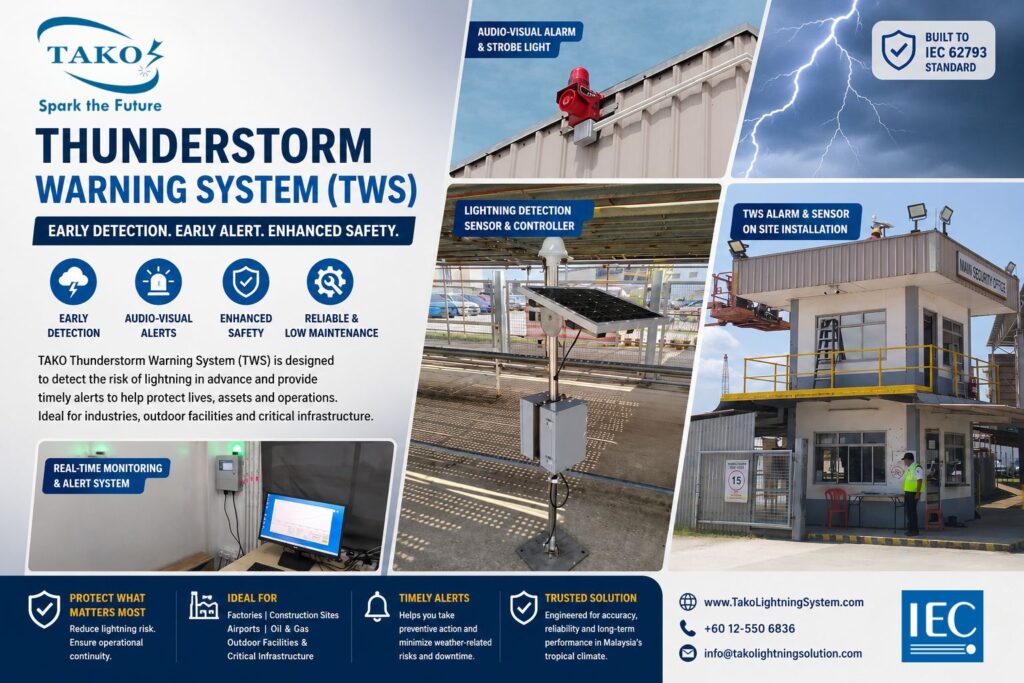
Full installation of the sensor mast, control unit, outdoor sirens, strobe lights, cabling, and earthing — carried out under PTW, using explosion-proof or zone-rated equipment where required by your facility’s area classification (ATEX/IECEx).
System Commissioning & Threshold Configuration
Alert distances, warning thresholds, siren tones, integration relay settings, and all-clear protocols are configured specifically for your facility. We verify detection range, siren audibility across all outdoor areas, and integration with your control systems.
EHS Team Training & Drill
Full training for your EHS team, supervisors, and control room operators on system operation, alert response protocol, evacuation procedures, and post-storm all-clear verification. Includes a simulated thunderstorm drill to verify your site’s response capability.
Documentation, Handover & Support
Full as-built drawings, system operating manual, DOSH compliance documentation, and maintenance schedule handed over to your team. TAKO provides ongoing maintenance, annual calibration, and 24/7 technical support for all installed Thunderstorm Warning Systems.
Thunderstorm Warning Systems & DOSH Malaysia Compliance
Under the Occupational Safety and Health Act 1994 (OSHA 1994), Malaysian employers have a legal duty to ensure the safety, health, and welfare of all workers — including protection from natural hazards such as lightning. For industrial facilities with outdoor workers, a lightning warning system for factory Malaysia is a recognised engineering control under DOSH’s hierarchy of hazard controls.
How a Thunderstorm Warning System Supports DOSH Compliance
- OSHA 1994 Section 15: Employer’s general duty to provide a safe working environment — a Thunderstorm Warning System directly fulfils this obligation for outdoor lightning hazards
- OSHA 1994 Section 16: Duty to prepare and maintain a written Safety and Health Policy — includes documented lightning safety protocol supported by the Thunderstorm Warning System’s data logs
- FMA 1967 — Factory & Machinery Act: Duty to maintain safe plant and equipment in factories; exposed outdoor plant and machinery create lightning risk that must be mitigated
- Hazardous Industries: For facilities under CIMAH (Control of Industrial Major Accident Hazards) regulations — Pasir Gudang, Kertih, Gebeng — Thunderstorm Warning Systems are a key element of the Major Accident Prevention Policy (MAPP)
- ISO 45001:2018: Occupational Health & Safety Management Systems — Thunderstorm Warning System event logs provide documented evidence of hazard identification and control measures for certification audits
- DOSH Lightning Safety Guidelines: DOSH recommends suspension of outdoor work when lightning is detected within 10 km — a Thunderstorm Warning System operationalises this guideline automatically
⚠ DOSH Employer Liability: In the event of a worker fatality or injury caused by lightning at an industrial facility, DOSH will investigate whether the employer had adequate lightning safety measures in place. The absence of a Thunderstorm Warning System at a high-risk outdoor industrial facility is likely to be found as a failure of the employer’s duty of care under OSHA 1994 — potentially resulting in prosecution, fines, and civil liability. Contact TAKO to assess and address your facility’s lightning safety obligations.
Required Documentation TAKO Provides
- Site lightning hazard assessment report
- Thunderstorm Warning System installation drawings and specifications
- System commissioning test report
- Calibration certificate and detection range verification
- DOSH-compatible lightning safety procedure document
- Annual maintenance and calibration records
Complete Your Industrial Lightning Protection with TAKO
A Thunderstorm Warning System protects your people. A complete industrial lightning protection solution from TAKO also protects your structures, equipment, and electronic systems — fully compliant with Malaysian standards. Explore TAKO’s related industrial lightning protection services.
Industrial Lightning Protection
Full MS IEC 62305-compliant external Lightning Protection System design and installation for factories, petrochemical plants, and industrial facilities — air termination, down conductors, earth termination, and bonding.
Industrial LPS Services →
MS IEC 62305 LPS Compliance
Mandatory lightning protection system design, risk assessment, and installation per MS IEC 62305 — the Malaysian national standard applicable to all buildings and structures, including industrial facilities and process plants.
MS IEC 62305 Services →
IEC 61643 Surge Protection (SPD)
Industrial-grade Surge Protective Devices for power, data, and telecom lines per IEC 61643 — protecting sensitive process control equipment, PLC systems, and instrumentation from lightning-induced surges and LEMP.
SPD Services →
Thunderstorm Warning Systems Malaysia — FAQ
Common questions from Malaysian industrial EHS managers, plant safety officers, and facility engineers about Thunderstorm Warning Systems, lightning warning systems for factory Malaysia environments, and TAKO’s industrial lightning safety services.
Deploy a Thunderstorm Warning System at Your Malaysian Facility
TAKO’s industrial lightning specialists will assess your facility, design the optimal Thunderstorm Warning System configuration, and deliver a fully commissioned, DOSH-compliant lightning warning system for factory Malaysia — with all documentation, training, and ongoing support included. Don’t wait for an incident to act.
TAKO Lightning Solution | Industrial Lightning Protection | MS IEC 62305 LPS | IEC 61643 SPD Malaysia | Best Thunderstorm Warning System in Malaysia | TAKO on Google Maps
Project References Thunderstorm Warning Systems in Malaysia – TAKO