

If you are managing an industrial facility, a manufacturing plant, or a data center, you already know that power quality isn’t just a “technical detail”—it is the backbone of your entire operation. A single lightning strike or a significant utility switching surge can fry a $50,000 VFD or a $100,000 CNC machine in milliseconds.
When you start looking for protection, the first question on your mind is inevitably: What is the current industrial 3-phase surge arrester price, and what am I actually paying for?
In this comprehensive guide, we are going to break down everything that influences the cost of these critical components. From Type 1 heavy-duty arresters to Type 3 point-of-use protection, we will look at the market rates and the technical factors that dictate the final invoice.


What is the Average Industrial 3-Phase Surge Arrester Price?
For those looking for a quick budget estimate, here is the current market snapshot:
- Entry-Level (Type 2, 20kA – 40kA): $150 – $450
- Standard Industrial (Type 2, 80kA – 120kA): $500 – $1,200
- Heavy-Duty / Service Entrance (Type 1, 200kA+): $1,500 – $4,500+
- Specialized / Modular Units (High-end Brands): $2,000 – $6,000
The industrial 3-phase surge arrester price varies primarily based on its kA (kiloampere) rating, the “Type” classification, and the brand’s reliability certifications.
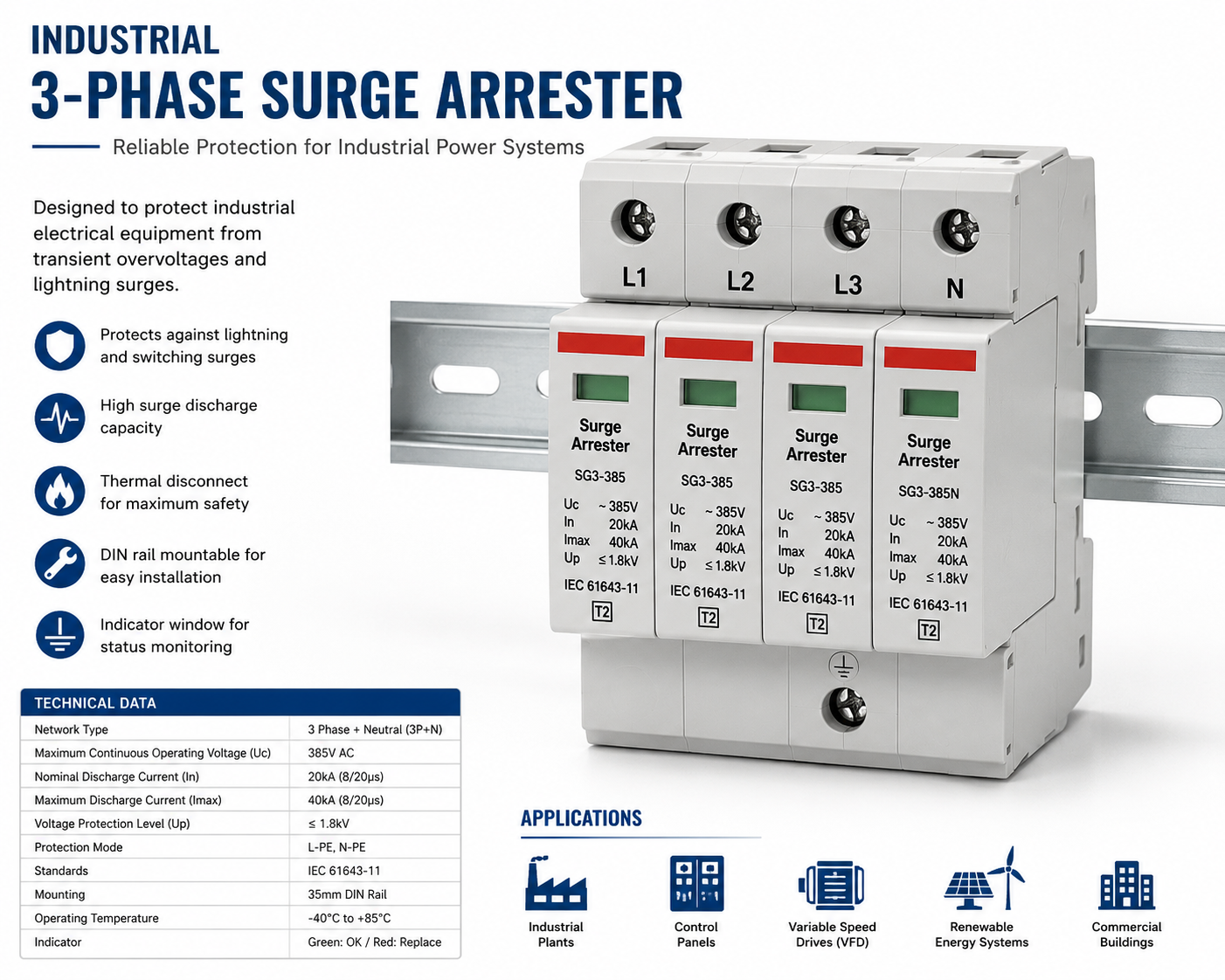
1. Why the Industrial 3-Phase Surge Arrester Price Varies So Much
It can be frustrating to see one unit priced at $200 and another that looks identical priced at $2,000. To understand the industrial 3-phase surge arrester price differences, you have to look under the hood.
Discharge Capacity (The kA Rating)
The most significant price driver is the kA rating. This is the maximum amount of surge current the device can shunt to the ground once.
- A 40kA unit is standard for a small sub-panel.
- A 200kA unit is designed for the main service entrance where the risk of a direct lightning strike is high.
As the kA rating doubles, the industrial 3-phase surge arrester price typically increases by 40% to 60% due to the increased volume of Metal Oxide Varistors (MOVs) required inside the unit.
The “Type” Classification
- Type 1: These are installed at the primary transformer or main breaker. They handle the “big hits.” Because they deal with massive energy, the industrial 3-phase surge arrester price for Type 1 is usually the highest.
- Type 2: These are for distribution panels. They are the most common industrial units. You’ll find that the industrial 3-phase surge arrester price for Type 2 is the most competitive due to high market volume.
- Type 3: Point-of-use protection. These are much cheaper but cannot protect an entire building.
2. Understanding the Technical Specs that Affect the Industrial 3-Phase Surge Arrester Price
When you receive a quote, don’t just look at the bottom line. Look at these technical specs, as they explain why the industrial 3-phase surge arrester price might be higher than expected:
Voltage Protection Level (Up)
The lower the “Up” value (let-through voltage), the better the protection. Engineering a device that can stop 10,000 volts and only let 600 volts through to your equipment is difficult. Therefore, a lower “Up” rating will usually increase the industrial 3-phase surge arrester price.
Modular vs. Non-Modular
- Non-Modular: If one phase blows, you replace the whole unit.
- Modular: You only replace the small plug-in cartridge.
While the initial industrial 3-phase surge arrester price for a modular system is 20-30% higher, the long-term maintenance cost is significantly lower.
Monitoring and Diagnostics
In a modern “Industry 4.0” facility, you need to know if your protection is still active. Units that include dry contacts (for remote monitoring), audible alarms, or LED health indicators will naturally have a higher industrial 3-phase surge arrester price than “dumb” units that offer no feedback.
3. Comparing Brands: Who Offers the Best Industrial 3-Phase Surge Arrester Price?
Tier 1: The Premium Giants (Schneider, ABB, Siemens)
These brands set the gold standard. When you look at the industrial 3-phase surge arrester price for a Schneider Acti9 or an ABB OVR series, you are paying for rigorous UL 1449 4th Edition testing and global support. Expect to pay a 25% premium here.
Tier 2: The Industrial Workhorses (Eaton, Littlefuse, Phoenix Contact)
These brands offer incredible reliability and are often the “sweet spot” for procurement managers. The industrial 3-phase surge arrester price for Eaton units is often very competitive while still meeting all heavy-industrial safety codes.
Tier 3: The Value-Focused Manufacturers
Brands like CITEL or specialized regional manufacturers often provide the best industrial 3-phase surge arrester price for simple applications. If you are protecting a non-critical pump or a small workshop, these are excellent choices.
4. How to Calculate the ROI of an Industrial 3-Phase Surge Arrester
It is easy to get sticker shock when looking at a $3,000 quote, but you must compare the industrial 3-phase surge arrester price against the cost of failure.
Example Scenario:
- Cost of Arrester: $1,200
- Cost of Installation: $400
- Total Investment: $1,600
- Equipment Value: $85,000 (CNC Machine + PLC)
- Downtime Cost: $2,000 per hour.
If a surge happens and you don’t have protection, you aren’t just out $85,000 for the machine; you are out $16,000 for an 8-hour shift of lost production. In this light, the industrial 3-phase surge arrester price is less than 1% of your potential risk.
5. Hidden Costs: What Isn’t Included in the Industrial 3-Phase Surge Arrester Price?
When budgeting, remember that the “box price” isn’t your total cost of ownership.
- Installation Labor: 3-phase systems require a licensed industrial electrician. Depending on your region, this can add
200–200–800 to the total industrial 3-phase surge arrester price. - Enclosures: If the unit is being installed outdoors or in a wash-down food environment, you need a NEMA 4 or 4X rated enclosure. This can add
100–100–300. - Cable Length: The longer the wires leading to the arrester, the less effective it is. Sometimes you need specialized mounting hardware to keep leads short, slightly bumping up the total industrial 3-phase surge arrester price.
6. Does a Lower Industrial 3-Phase Surge Arrester Price Mean Lower Quality?
In the electrical world, you usually get what you pay for. A suspiciously low industrial 3-phase surge arrester price often indicates:
- Lack of Thermal Disconnect: Cheap units can catch fire if they undergo a sustained overvoltage.
- Lower Surge Life: A cheap unit might handle one surge and die, whereas a premium unit can handle hundreds of smaller surges over a decade.
- No Warranty for Connected Equipment: Some premium brands include a warranty that covers the equipment behind the arrester. A cheaper industrial 3-phase surge arrester price never includes this.
7. Industry-Specific Pricing Trends
The industrial 3-phase surge arrester price can also fluctuate based on the specific industry you are in.
- Renewable Energy (Solar/Wind): These require DC-specific or high-voltage AC arresters. The industrial 3-phase surge arrester price here is often 20% higher due to the unique wave patterns of inverters.
- Data Centers: These require ultra-low let-through voltages. The precision engineering required drives the industrial 3-phase surge arrester price toward the top end of the scale.
- Water Treatment Plants: Because of the high risk of corrosion, the enclosures and materials used increase the industrial 3-phase surge arrester price.
8. FAQs About Industrial 3-Phase Surge Arrester Price
How often do I need to replace them?
Most industrial units last 5–10 years. However, if your facility is in a lightning-prone area (like Florida or Southeast Asia), you might need to replace modules more often. Factoring this into your initial industrial 3-phase surge arrester price calculation is vital.
Can I use a residential unit for a 3-phase industrial motor?
No. Residential units are single-phase and lack the kA capacity. Attempting to save on the industrial 3-phase surge arrester price by using consumer-grade gear is a fire hazard and will violate your insurance policy.
Does the industrial 3-phase surge arrester price include shipping and taxes?
Usually, online listed prices do not. For bulk industrial orders, you can often negotiate a better industrial 3-phase surge arrester price through a wholesale distributor.
Is there a difference between a “Surge Arrester” and an “SPD”?
Technically, “Arresters” are for high-voltage (over 1000V) and “SPDs” are for low-voltage (under 1000V). However, in common conversation, people use them interchangeably. Ensure you are looking at the correct voltage range when checking the industrial 3-phase surge arrester price.
9. Conclusion: Choosing the Right Protection for Your Budget
Navigating the industrial 3-phase surge arrester price landscape requires balancing your current budget with your long-term risk tolerance. If you are protecting a mission-critical server farm, the $4,000 premium unit is a bargain. If you are protecting a small hydraulic press in a low-risk area, a $400 Type 2 unit is likely sufficient.
Don’t let a “low price” be your only guide. Look for UL certifications, kA ratings that match your local environment, and a brand that will be around in ten years to provide replacement modules.
Stop Risking Your Infrastructure Today
Are you ready to protect your facility? Don’t wait for the next storm to realize you are unprotected.
TAKO’s Credentials


Disclaimer
The information provided in this blog is intended for general informational purposes only. Prices, specifications, and availability may vary depending on suppliers, location, and market conditions. Readers should verify details directly with suppliers or manufacturers before making purchasing decisions. The author and website are not responsible for any errors, omissions, or outcomes resulting from the use of this information. Always consult a professional for advice tailored to your specific needs.